I must be lonely I guess, because two days in row I’ve written haiku about silence, and it’s true that I’ve been living a very solitary life lately.
Almost all of my friends have dropped away from me, one way and another, and I seem to have completely lost the knack of making new friends . . . I’ve heard this situation is pretty common for “middle-aged” men.
But enough of my self-pity, and on to the slightly more inspiring subject of this post – the Southern Cross and the Eureka Flag.
This week marked 170 years since the battle at the Eureka Stockade in Ballarat (3rd of December, 1854), when gold miners revolted against the soldiers and police of newly established Colony of Victoria.
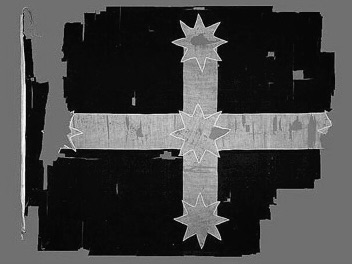
The Eureka Flag (pictured below), is the flag the miners fought beneath, and it depicts the constellation of the Southern Cross. It is a complex and potent symbol in Australian culture: it may be taken to represent colonial Australia developing its own identity in opposition to British authority; and more generally as a symbol of resistance against oppression and authoritarianism; and for many the flag embodies an anti-authoritarian temperament that is seen as distinctly Australian.
The Southern Cross, with five stars, is often used to represents Australia, and of course it features on the current Australian flag. The Southern Cross with four stars represents Aotearoa. Why? I seem to remember someone telling me when I was young, that the fifth star of the Southern Cross, Epsilon, is visible from Australia, but not from New Zealand.
170 years later the Eureka flag is still a common sight in Victoria. It is used by Australian unions and is frequently seen at protests, and flying from cranes on buildings sites.
On a far less positive note, extreme nationalists and white-supremacists have tried to make use of the Eureka Flag to promote their xenophobia.
The word “eureka” is taken from the Greek, meaning something like “I’ve found it!” It is apparently what Archimedes said, when he was getting into a bath, and suddenly understood the principle of fluid displacement (and then, according to the legend, in his excitement, he ran naked through the streets of Syracuse).
The Eureka Stockade in Ballarat, where the miners fought the colonial government soldiers and police, was named “Eureka” because it was near the Eureka Mine (“eureka” being something you might shout if you struck gold).
And so “eureka” may be taken as something like an epiphany, a moment of inspiration or clarity . . . something like what haiku writers describe as a “haiku moment”.
      eureka . . .!
 a moment of clarity
      silent stars
 Clem Byard